
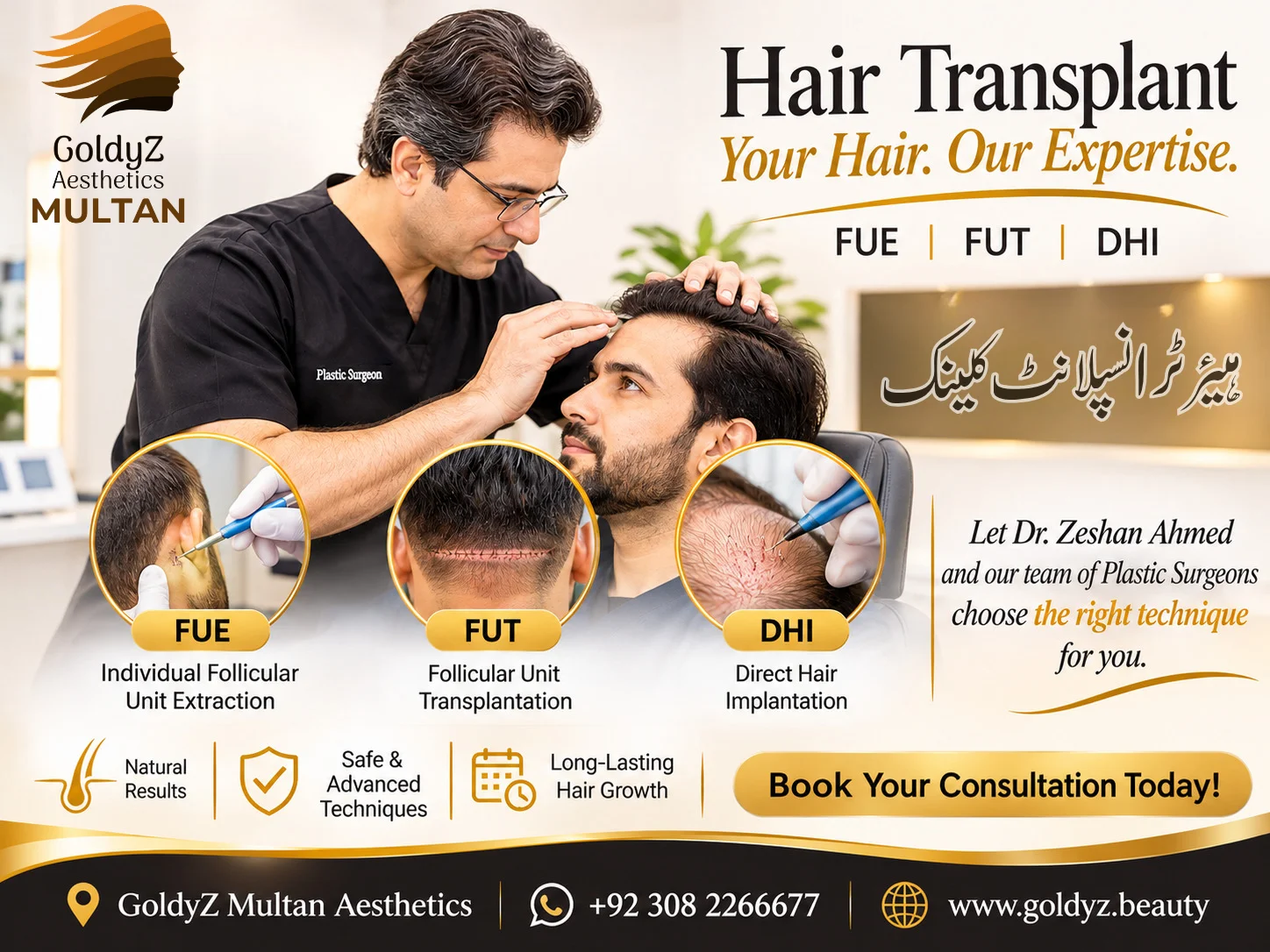

Follicular Unit Transplantation (FUT), Follicular Unit Extraction (FUE), and Direct Hair Implantation (DHI)
While all three share the same biological objective (redistributing permanent, DHT-resistant follicular units from the occipital/temporal donor fringe to miniaturized or recipient-depleted zones), they differ significantly in extraction mechanics, implantation workflow, scarring profiles, and clinical indications.
| Feature | FUT (Strip Surgery) | FUE (Standard Extraction) | DHI (Direct Implantation) |
| Donor Harvest | Linear strip excision from the occipital scalp; wound closed primarily with sutures/staples. | Individual follicular units extracted via micro-punches ($0.8\text{–}1.0\text{ mm}$ motorized or manual). | Individual follicular units extracted via micro-punches (identical extraction phase to FUE). |
| Recipient Site Preparation | Scalp incisions/slits pre-made with blades or needles prior to graft placement. | Scalp incisions/slits pre-made with blades or needles prior to graft placement. | Simultaneous: Loaded directly into a Choi Implanter Pen; implanted without pre-made incisions. |
| Graft Handling & Time | Dissected under stereomicroscopes; shorter out-of-body time per graft. | Handled with forceps and placed manually into pre-made slits; moderate out-of-body time. | Loaded immediately into pen needles; minimized handling and reduced air exposure time. |
| Primary Scar Pattern | Linear horizontal scar (hidden by hair worn at medium/long length). | Scatter of micro-punched white dot scars (concealable with short crops/fades). | Scatter of micro-punched white dot scars (dependent on the underlying FUE extraction method). |
Detailed Breakdown of Techniques
Follicular Unit Transplantation (FUT)
- The Process: A full-thickness strip of scalp tissue is excised from the safe donor zone. Assistants under stereomicroscopic magnification dissect individual 1-, 2-, and 3-hair follicular units from the strip to preserve the protective peribulbar dermis.
- Advantages:
- Highest single-session graft yield 3500 – 4000.
- Lowest transection rates when executed by experienced dissection technicians, preserving maximum follicular integrity.
- Preserves unharvested regions above and below the strip for future procedures.
- Limitations: Leaves a permanent linear scar; requires suture/staple removal at 10-14 days; longer initial postoperative discomfort and healing period.
Follicular Unit Extraction (FUE)
The Process: Individual follicular units are punched directly out of the scalp using hollow rotary or oscillating micro-punches. These grafts are temporarily stored in chilled hypothermic holding solutions before being manually inserted into pre-created recipient sites.
Advantages:
- Avoids a linear strip scar; allows patients to wear very short hairstyles (fades/buzz cuts) without exposing a linear scar line.
- Excellent versatility for large-to-moderate surface area coverage 1500 – 3000 grafts per session.
- Minimal immediate postoperative discomfort.
Limitations: Requires shaving the entire donor zone (and frequently the recipient zone); potential risk of donor-site overharvesting or visible spot-thinning if graft extraction density is miscalculated.
Direct Hair Implantation (DHI)
The Process: DHI is an evolutionary refinement of the FUE workflow. While the extraction phase utilizes standard FUE micro-punches, the implantation phase diverges entirely. Grafts are loaded into a spring-loaded Choi Implanter Pen, which simultaneously punctures the skin and deploys the follicle at a pre-calculated depth, angle, and direction.
Advantages:
- Eliminates the separate channel-creation step, granting exceptional surgeon control over angulation, depth, and hair orientation (crucial for hairline design and crown swirls).
- Reduced graft ischemia time (time spent outside the body).
- Ideal for hair-addition procedures (increasing density in thinning areas containing existing native hair) because the pen needle prevents trauma to adjacent miniaturized strands.
Limitations: Significantly slower procedure time per graft, driving up operational costs; typically less suited for mega-sessions exceeding 3500 – 4000 grafts in a single day due to logistical and time constraints.
Which Technique is Better?
Surgeon’s Technique Selection Criteria: FUE vs. FUT vs. DHI
There is no single universally superior hair transplant technique among FUE, FUT, and DHI, as the best approach depends on the patient’s degree of hair loss, donor hair availability, scalp characteristics, desired density, and long-term hair restoration goals. FUE (Follicular Unit Extraction) is widely preferred because it involves extracting individual follicular units, leaves tiny dot-like scars, offers faster recovery, and avoids a linear scar. FUT (Follicular Unit Transplantation) involves removing a thin strip of scalp from the donor area and dissecting it into individual grafts, making it useful when a large number of grafts are required, although it leaves a linear scar. DHI (Direct Hair Implantation) is essentially a refined implantation approach, generally using a specialised implanter pen to place extracted follicles directly into the recipient area, allowing precise control over implantation angle, direction, and depth. Ultimately, FUE and DHI are not entirely separate extraction techniques, as DHI commonly uses FUE for graft harvesting. The most appropriate technique should be selected after a thorough assessment by an experienced hair transplant surgeon, prioritising natural-looking results, donor area preservation, and long-term hair growth rather than simply choosing the latest technique.
At GoldyZ Multan Aesthetics, we offer all three advanced hair transplant techniques, FUE, FUT, and DHI, to provide personalised hair restoration solutions for our clients. Under the supervision of Dr. Zeshan Ahmed, in collaboration with our experienced team of Plastic Surgeons, every patient undergoes an individual assessment of their hair loss pattern, donor area, scalp condition, and restoration goals. Our team then recommends the most suitable technique based on medical considerations, ensuring a customised approach focused on natural-looking results, optimal graft survival, and long-term hair restoration. At GoldyZ, we don’t believe in a one-technique-fits-all approach. We believe in choosing the right technique for every individual.
Ready to restore your hair and confidence? Book your personalized FREE hair transplant consultation at GoldyZ Multan Aesthetics today. Let us help you choose the right hair restoration technique for lasting, natural-looking results.
Book Your Consultation Today!
📍 GoldyZ Multan Aesthetics
📲 WhatsApp: +92 308 2266677
🌐 www.goldyz.beauty